
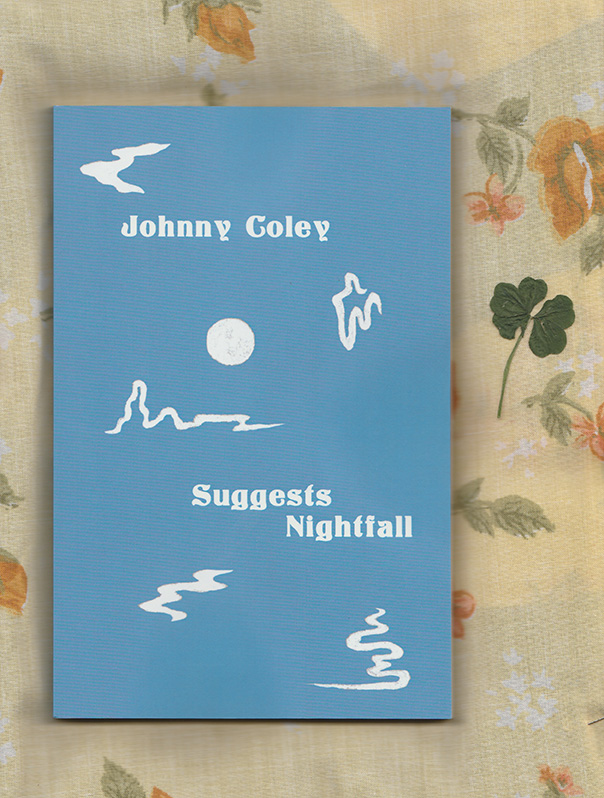
Johnny Coley - Suggests Nightfall
First Edition Paperback
110 pages
Order
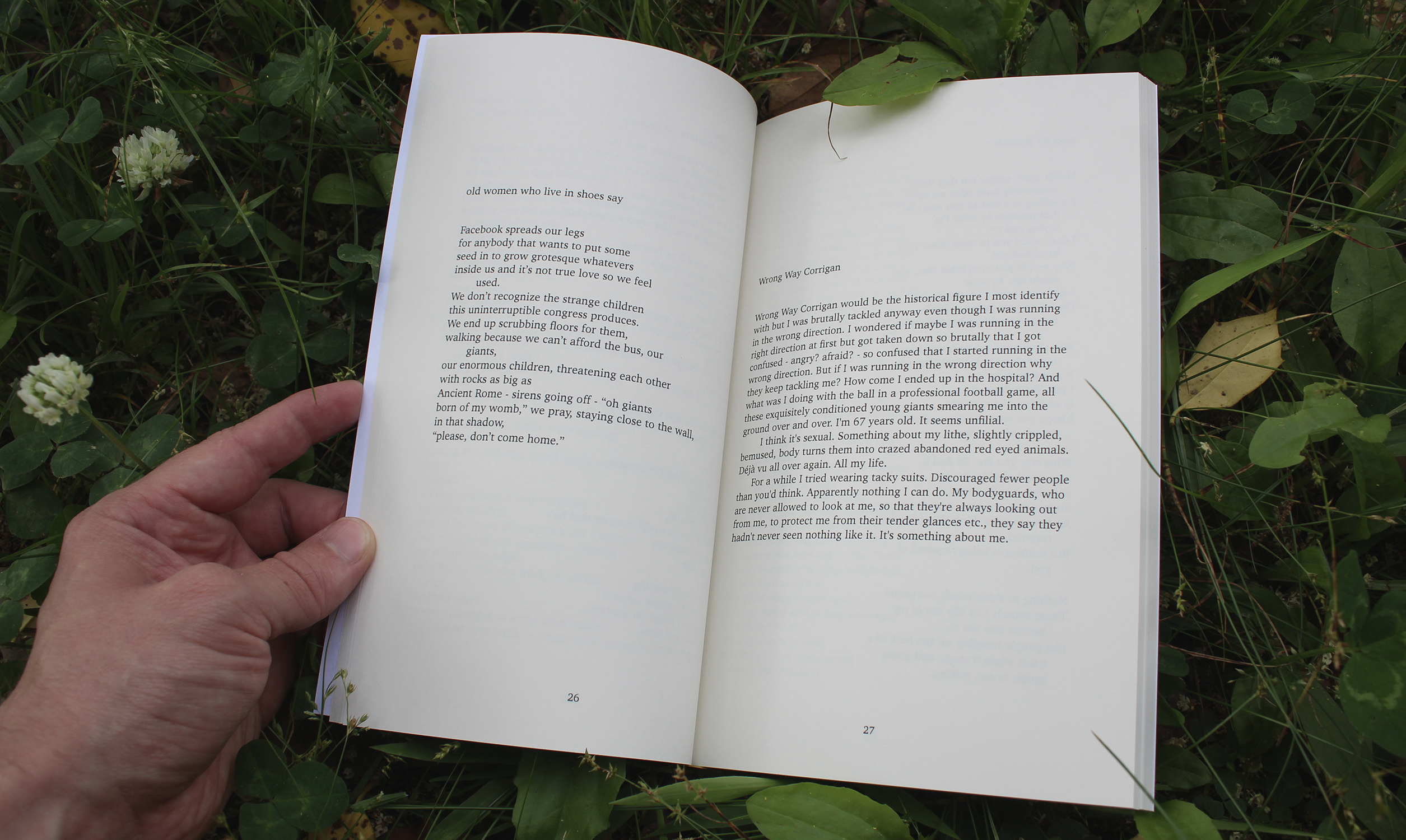
Suggests Nightfall is like a surreal Southern diary brimming with sensuous language and biting wit. In this, his fourth book, Johnny Coley takes us to that liminal space at the edges of language, where ideology loses its enchantment and it's possible to see beyond the veil. Taking cue from Situationist and Surrealist writers, Coley's prose poetry melds street level observations with wild free verse to invoke a prismatic view of reality. This collection of writings made between the mid-90s and 2020, is a brilliant chronicle of queer life as told by a sage of the Birmingham experimental scene. Coley's ability to improvise words in a live musical setting is an utterly entrancing experience that many have had the pleasure of witnessing in the past few years. Now, finally, here is the magic dust of his daily life; a deeper dive into a prolific and ongoing transformation of words into "another music." His lyrical narratives here are at turns poignant and hilarious, conveying the absurd experience of living within the paradoxes of our current sociopolitical state. Beyond that there is the primal beauty of earth, sky, wind and dreams that the self can dissolve into. Suggests Nightfall takes you there.
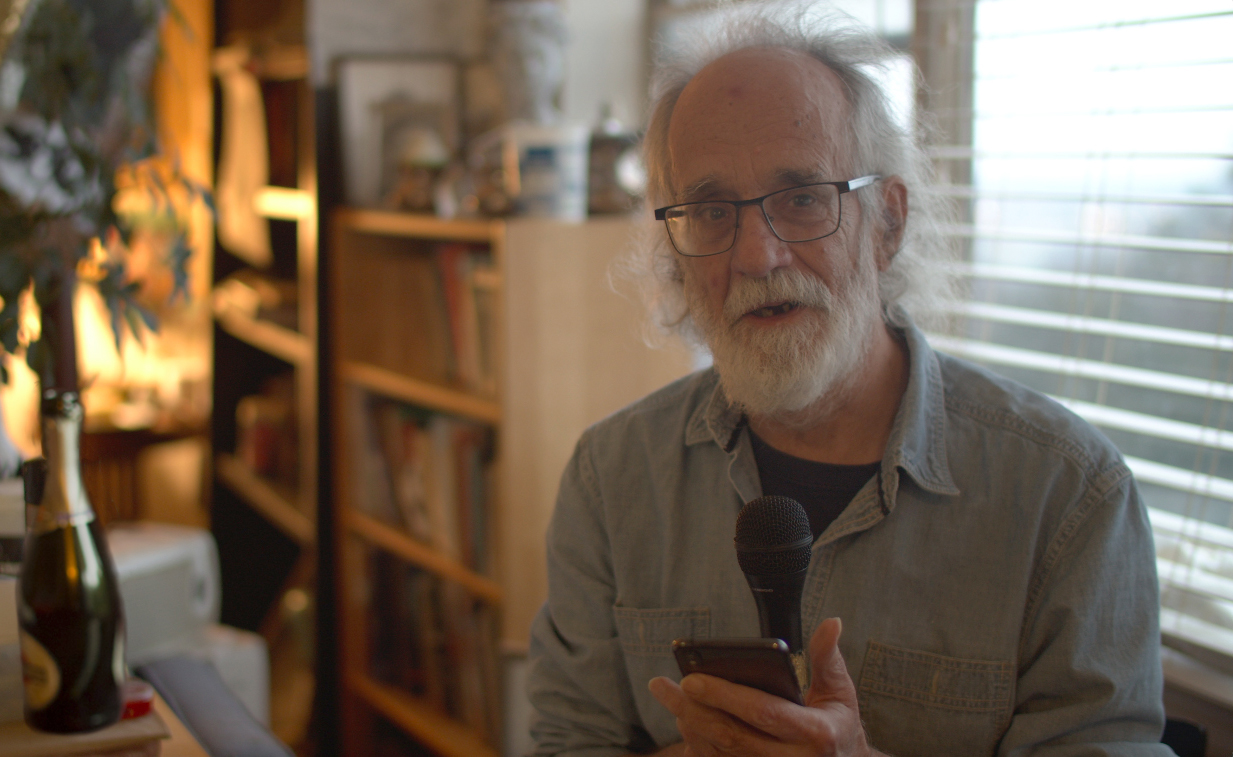
Johnny Coley is a poet, painter and performer living in Birmingham, Alabama. He has performed improvised spoken word since the 1970s with an array of musical collaborators including Davey Williams, LaDonna Smith, Jimmy Griffin and others.
Here’s a nugget about one of Johnny’s recordings:
On “Landscape Man”
Robert Desnos dreamed:
I saw Davey Williams and Johnny Shines playing dice with Fred Lane; Isaiah Owens and Andrei Tarkovsky witnessing to a UAB anthropology graduate student; at one point Diogenes the Cynic leaned his head in the door, then moved on. Fred Shuttlesworth, trumpet in hand, kept shouting, “Where’s the one? Where’s the one” Thomas Blanton, Robert Chambliss, and Bobby Cherry, dressed in immaculate white Sufi gowns, whirling and whirling and whirling. I saw John Cage kissing the ghost of a Muskogean warrior.
Why was it so cold? The musicians, crammed on the stage, (I don’t even remember them gathering there) became a prone, sleeping giant, on its side, with its back to the floor; Slow exhales, then Inhalations. The slow rising and falling of its chest. The slow, rising and falling of the music, musicians breathing through their instruments with their hands free. I heard klezmer, chopped and screwed trad jazz, Pharoah blowing spit out of his sax. The Surrealists loved Desnos because he could fall asleep at will.
As a prism separates white light into many colors or many colors are joined into one white beam, so music often works. Sonny Blount humming harmony to the quantum universe. Remembering the Birmingham Jubilee Singers in 1927, stepping up to the new electric microphone and reminding all of the children to moan, children moan. In a fire house, near the center of Birmingham, one chord in many colors, and many colors in one chord.
Elsewhere, at the same moment, a boy in Trussville looked up at the sky in time to see a green falling star, full of iron, dropping as slow as a flare, and disappearing below the tree line; a group of friends outside a restaurant in Pelham: “Hey, I got two 1951 silver quarters in my change”; two strollers in Mountain Brook whispering: “It’s a little cold, but still a fine night.”
— notes by Kevin Nutt, Alabama Dept. Of Archives & History
First Edition Paperback
110 pages
Order
Suggests Nightfall is like a surreal Southern diary brimming with sensuous language and biting wit. In this, his fourth book, Johnny Coley takes us to that liminal space at the edges of language, where ideology loses its enchantment and it's possible to see beyond the veil. Taking cue from Situationist and Surrealist writers, Coley's prose poetry melds street level observations with wild free verse to invoke a prismatic view of reality. This collection of writings made between the mid-90s and 2020, is a brilliant chronicle of queer life as told by a sage of the Birmingham experimental scene. Coley's ability to improvise words in a live musical setting is an utterly entrancing experience that many have had the pleasure of witnessing in the past few years. Now, finally, here is the magic dust of his daily life; a deeper dive into a prolific and ongoing transformation of words into "another music." His lyrical narratives here are at turns poignant and hilarious, conveying the absurd experience of living within the paradoxes of our current sociopolitical state. Beyond that there is the primal beauty of earth, sky, wind and dreams that the self can dissolve into. Suggests Nightfall takes you there.
Johnny Coley is a poet, painter and performer living in Birmingham, Alabama. He has performed improvised spoken word since the 1970s with an array of musical collaborators including Davey Williams, LaDonna Smith, Jimmy Griffin and others.
Here’s a nugget about one of Johnny’s recordings:
On “Landscape Man”
Robert Desnos dreamed:
I saw Davey Williams and Johnny Shines playing dice with Fred Lane; Isaiah Owens and Andrei Tarkovsky witnessing to a UAB anthropology graduate student; at one point Diogenes the Cynic leaned his head in the door, then moved on. Fred Shuttlesworth, trumpet in hand, kept shouting, “Where’s the one? Where’s the one” Thomas Blanton, Robert Chambliss, and Bobby Cherry, dressed in immaculate white Sufi gowns, whirling and whirling and whirling. I saw John Cage kissing the ghost of a Muskogean warrior.
Why was it so cold? The musicians, crammed on the stage, (I don’t even remember them gathering there) became a prone, sleeping giant, on its side, with its back to the floor; Slow exhales, then Inhalations. The slow rising and falling of its chest. The slow, rising and falling of the music, musicians breathing through their instruments with their hands free. I heard klezmer, chopped and screwed trad jazz, Pharoah blowing spit out of his sax. The Surrealists loved Desnos because he could fall asleep at will.
As a prism separates white light into many colors or many colors are joined into one white beam, so music often works. Sonny Blount humming harmony to the quantum universe. Remembering the Birmingham Jubilee Singers in 1927, stepping up to the new electric microphone and reminding all of the children to moan, children moan. In a fire house, near the center of Birmingham, one chord in many colors, and many colors in one chord.
Elsewhere, at the same moment, a boy in Trussville looked up at the sky in time to see a green falling star, full of iron, dropping as slow as a flare, and disappearing below the tree line; a group of friends outside a restaurant in Pelham: “Hey, I got two 1951 silver quarters in my change”; two strollers in Mountain Brook whispering: “It’s a little cold, but still a fine night.”
— notes by Kevin Nutt, Alabama Dept. Of Archives & History